015 SPOTLIGHT: TORUS TORUS STUDIO
Torus Torus Studios is the name used for collaborative work by the recently-married artists Colin Rennie and Alexandra Carr, who also have their own fertile individual practices. Both trained as artists but have been drawn to science. They came together, they say, ‘over our joint understanding that there is a commonality in the modes of expression between science and art, between the humanities and rationalism, between dualism and monism’. The first major Torus Torus production was a commission by the Science Museum. The large, kinetic overhead sculpture, Only Breath, is central to the display ‘Energy Revolution’ in the Adani Green Energy Gallery, which explores how the world can generate and use energy more sustainably to limit climate change. Only Breath opens and closes rather like a flower as it references renewable energy technology and highlights the natural processes and phenomena that such technologies harness. By evoking natural balance, breathing and blooming, it signifies the power of nature to stimulate technological change. The chosen materials were inspired by the need for energy revolution: repurposed mirror, infinitely recyclable stainless steel, wind-blown carbon-storing wood … And, looking beyond the science, Only Breath also draws inspiration from the Rumi poem of the same name [i].
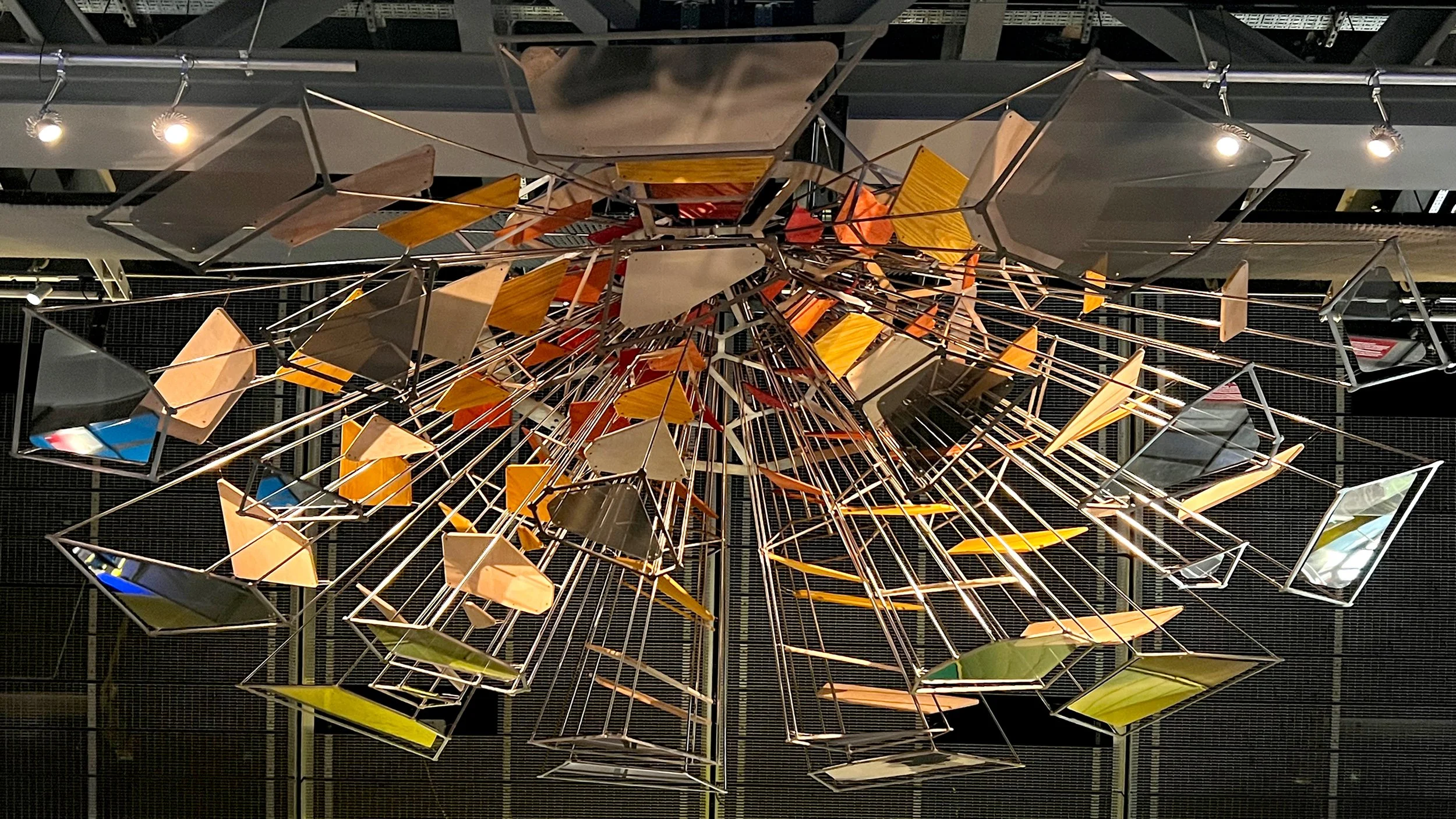
Only Breath, 2024. Stainless steel, mild steel, windblown wood, motorised mechanism. 5m diameter.
What’s the difference between you as individual artists and Torus Torus Studios?
AC: I am interested in natural phenomena and geometry and mathematics through nature. I like to push materials by working experimentally with them: fog, magnets, crystal growth …
CR: I am more concrete in how I work with materials, with lots of hidden engineering. I use a design perspective to make something work as beautifully, and look as pure, as possible.
AC & CR: But we have many overlapping themes within our work, and complementary skills, so we work together quite naturally. We found we were often helping each other, so it made sense to recognise that as a joint practice.
And why ‘Torus Torus’?
AC & CR: We chose the name based on a sculpture idea we were working on: the torus [ii] as a mathematical model for an unending ‘looping’ universe with no beginning and no end was in both of our minds. The idea to interlock two tori like links in a chain emerged quite naturally, and also became symbolic of our relationship as artists with complementary skills. Torus alone didn't seem right, but doubling the word and linking the object resonated better.
What has inspired your particular combination of science and art?
If you’re interested in natural phenomena, you’re going to look at the science behind that. We want to peek under the surface of all the beauty that’s going on and understand it. We’ve always been inspired by scientific ideas as a code for how to explain the world. Science is often misconstrued as all logical, strict, dispassionate – but when you talk to scientists they often have hunches about their ideas, they go with feelings. Scientists don’t look at an area because it’s correct, but because they are passionate about it. In maths, you need to think in a very abstract way to have a new leap of understanding. Mathematicians have to unlearn the world around them, put themselves in a make-believe space in order to get to these new ideas. So scientists and artists are both in the business of trying to explain the wonder they see in the world – the driver is similar. However the currency of science – data, falsifiability, accuracy, facts – is quite different from the currency of art – wonder, awe, inspiration, the intangible. That makes it difficult to satisfy a scientific brief with an art outcome …
How do you look to do that?
We’re more in the field of the wonder than of data – even though we do deal with a lot of data. We see it as a sign of a successful artwork when we trigger people to ask more questions.
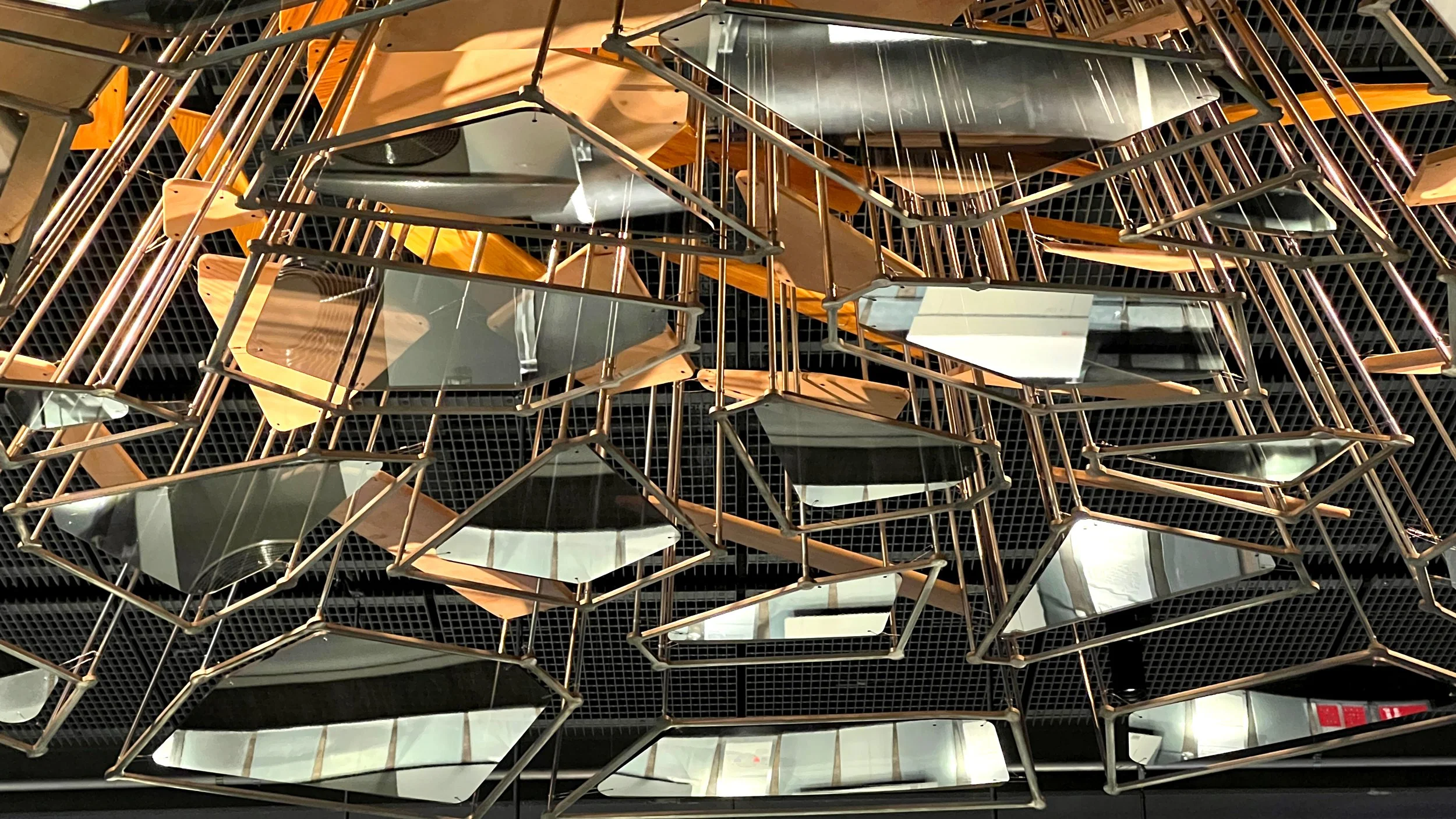
Only Breath, 2024. Stainless steel, mild steel, windblown wood, motorised mechanism. 5m diameter.
What is the science behind Only Breath?
There’s a lot of biomimicry – algorithmic mimicry of natural processes, for example the treatment of Voronoi diagrams by Lloyd’s algorithm [iii]. That’s interesting as it is biomimetic in its structure, as when it takes a circle and expands a set of circles from their c-points, and where those circles meet each other they form a plane – bubbles obey the 3D Voronoi algorithm. When Only Breath is in a closed position, there’s a dome to the bottom layers of the mirror, it almost resolves to a flat plane, then curves out to an opposite direction, and that references the move to renewable technology through solar field arrays [iv]. And there’s also a subtle spiral hidden within the form. That’s a nod to the Fibonacci spiral [v]. From a sacred geometry point of view, a spiral is a symbol of introspection, as well as a connection to the outer world, so it’s playing on the idea of the individual being a very small part of a big machine but having some influence over that – as in the energy transition being such a big, big problem and such a nuanced and complicated system that it really does involve everyone. And the whole piece moves from one single point of motion, one single motor, just as how a flower comes from one single point. That references how a small change can have a big effect. There’s also the obvious fact that it’s a machine moving in this graceful way.
It is slow-moving by kinetic art standards?
It follows sinusoidal motion [vi], so it’s slow at the beginning of the three minute cycles, speeds up, then slows down again to create these almost imperceptible changes. It is designed so that, when you are directly beneath it, there’s a sense of vection – of not knowing whether it is you moving or your environment moving, as in the classic case of sitting on a train when the train next to you starts moving. As you gaze up from beneath it, you don’t quite know whether it is moving or not, or whether it has stopped. We had to fight quite hard to keep it so slow. Initially the Science Museum wanted it to be faster. That said, we do have three settings in the profile, so it can be speeded up – a disco version might be possible!
What about the engineering?
The engineering is evident, the workings are not hidden, and that’s important to us. It is required to last 10-15 years with minimal maintenance, which was a real challenge, especially if you want to say something poetic while all that engineering is going on. If you change one aspect – for example the shape of the spiral – then every other component needs to change, so it was a matter of going back and forth to find a sweet spot where it would look right but also physically work. That hammered home to us how unbelievably efficient the unfolding mechanism of a flower has to be. That gives you an appreciation for how nature resolves the equivalent problems through little bit of imperfection, by balancing to and fro. A contrast to how, as humans, we often try to impose a perfect order that is unachievable.
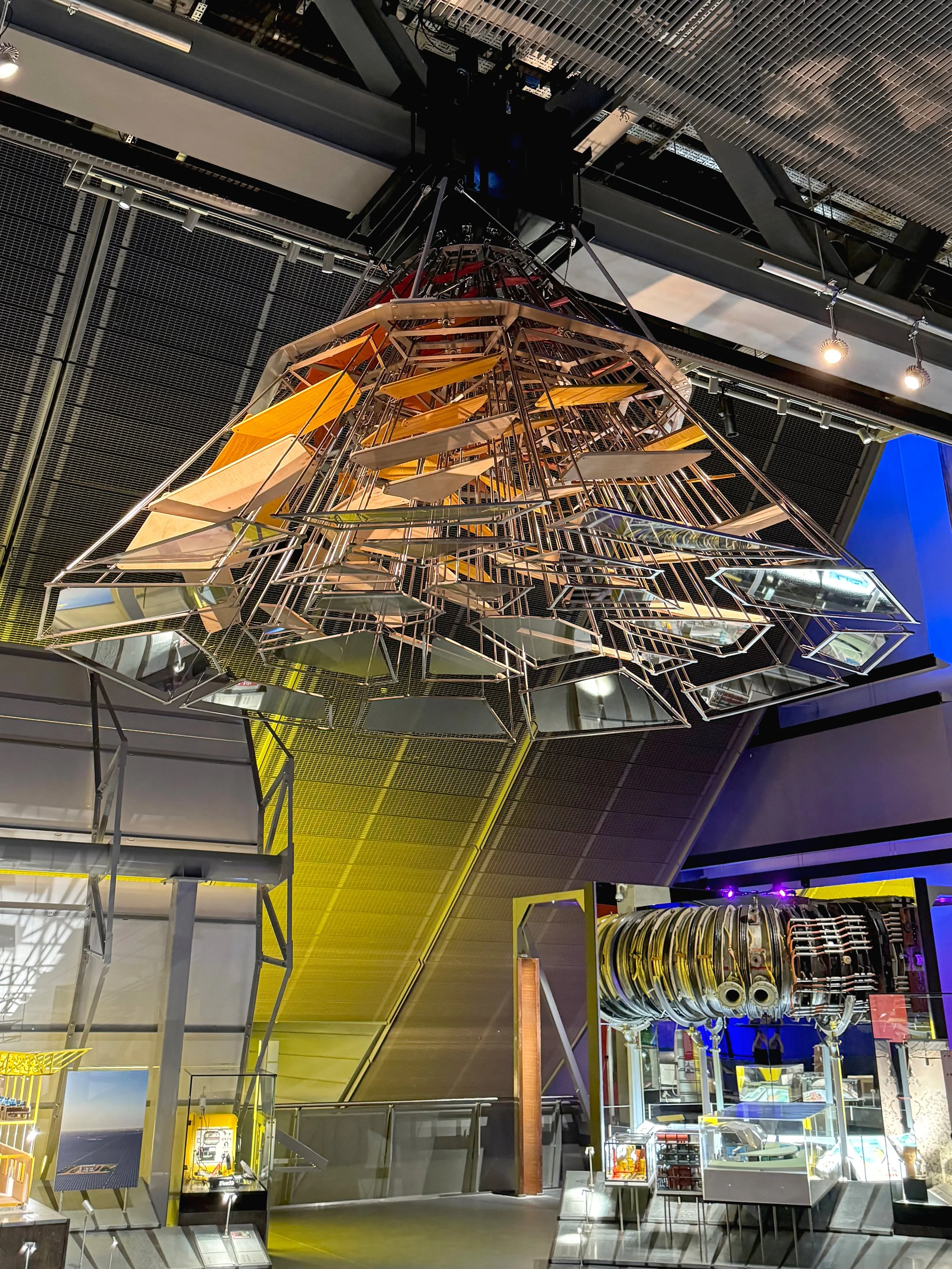
Only Breath, 2024, installation shot at the Science Museum, London. Stainless steel, mild steel, windblown wood, motorised mechanism. 5m diameter.
What do you hope for?
The aim is to achieve an interplay between technology and beauty such that an artist, an engineer, a geographer – anyone – might get something from it. Just as it will need a lots of minds and skill sets coming together to address the climate challenge.
Can we see other works by Torus Torus Studios currently?
Strictly speaking, no, as Only Breath is the first work we’ve presented as collaborative. But we have worked together for seven years, helping each other with individually attributed works. For example, we were both involved in a similar way in ‘Solaris Nexum’, a permanent, publicly-viewable work in the atrium of the central quad of the Technological University, Dublin – although that is labelled as by Alexandra Carr.
What’s next?
Coming up – we hope – will be an even bigger commission. We can’t talk about it yet, but we’re on the shortlist of two for a project that will dwarf our previous works by an order of magnitude!
Only Breath by Torus Torus Studios is on permanent display at the Science Museum, London.
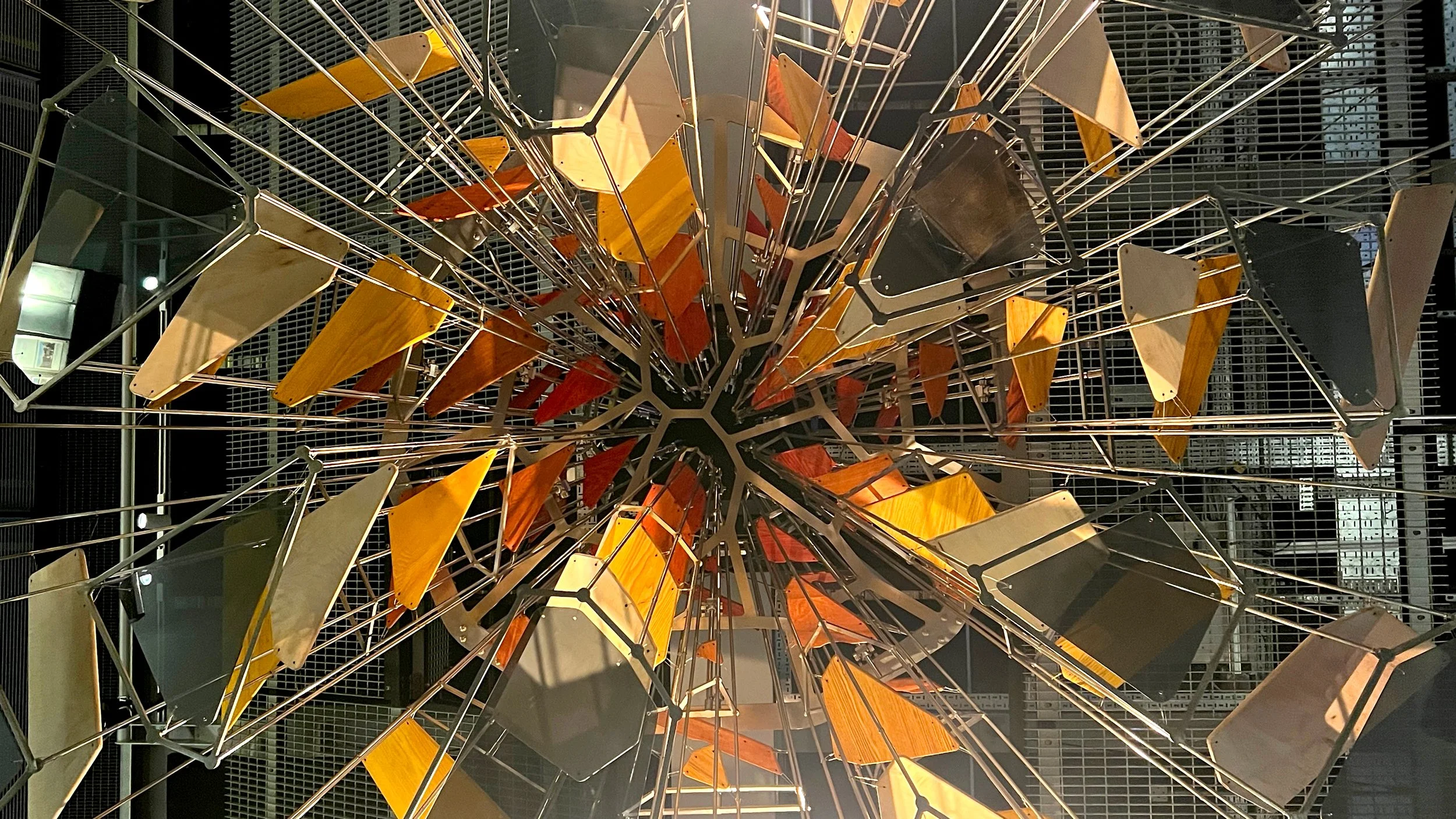
Only Breath, 2024. Stainless steel, mild steel, windblown wood, motorised mechanism. 5m diameter.
[i] Only Breath by Rumi
Not Christian or Jew or Muslim, not Hindu
Buddhist, Sufi, or Zen. Not any religion
or cultural system. I am not from the East
or the West, not out of the ocean or up
from the ground, not natural or ethereal, not
composed of elements at all. I do not exist,
am not an entity in this world or in the next,
did not descend from Adam and Eve or any
origin story. My place is placeless, a trace
of the traceless. Neither body or soul.
I belong to the beloved, have seen the two
worlds as one and that one call to and know,
first, last, outer, inner, only that
breath breathing human being.
[ii] In mathematics, a torus is a doughnut-shaped object such as an O-ring. It is formed by rotating a closed curve, especially a circle, about a line which lies in the same plane but does not intersect it.
[iii] A Voronoi diagram is a diagram pattern that divides space into regions based on proximity to a set of points in a plane, ensuring each region contains all space closer to one point than any other. If you have n points scattered on a plane, the Voronoi diagram of those points subdivides the plane in exactly n cells enclosing the portion of the plane that is the closest to each point. This produces a tessellation that completely covers the plane, as in – for example – the pattern on a giraffe’s coat. Lloyd’s algorithm (also known as a Voronoi iteration) iteratively constructs Voronoi diagrams and then moves each point to the centroid of its corresponding cell to produce more regularly shaped and evenly distributed cells. Torus Torus explain that they also needed to ensure that the outer edge of each of the cells was perpendicular to the radii from the single central point of motion so that the gimbal hinge arrangement that they designed would operate smoothly without twisting. They worked through this process iteratively, using grasshopper with -Kangaroo physics, re-inputting the recalculated centroids each time for a new Voronoi diagram to be drawn (automating this using anemone was possible but we found there was too much human input needed to maintain the desired aesthetic distribution of the cells). The optimisation of the cell centroid adjustment and relaxation needed to even out the edge length and maintain perpendicularity of the outer edge turned out to be operating a form of Lloyd's algorithm.
[iv] Solar furnaces and some arrays of solar panels use solar trackers that adjust the panels' position throughout the day to maximize sunlight capture.
[v] A Fibonacci spiral is a visual representation of the Fibonacci sequence, where each number is the sum of the two preceding ones (1, 1, 2, 3, 5, 8, etc.). It is constructed by drawing arcs within a series of squares whose side lengths correspond to the Fibonacci numbers. This creates a spiral shape that approximates the Golden Spiral, which is based on the Golden Ratio.
[vi] The motion of an object in simple harmonic motion is sinusoidal: its values – such as displacement, velocity and acceleration – vary in the shape of a sine or cosine curve.
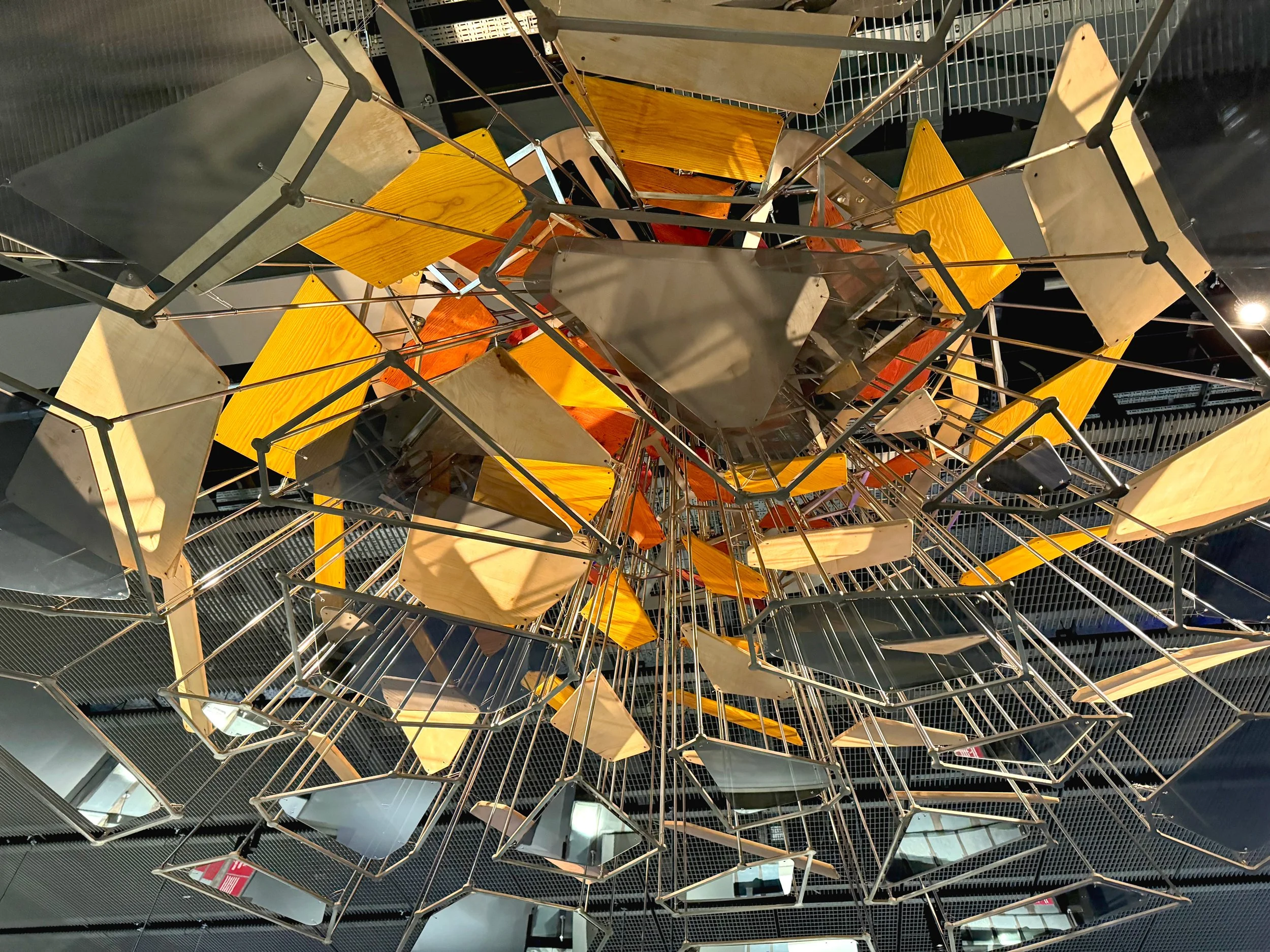
Only Breath, 2024. Stainless steel, mild steel, windblown wood, motorised mechanism. 5m diameter.
Images and video shown courtesy the artists © Torus Torus Studios. All rights reserved.